
Introduction
Contract management is evolving from a reactive administrative function into a proactive, data-driven discipline. Organizations are no longer satisfied with simply storing agreements or tracking renewal dates—they want to anticipate risks, optimize value, and align contracts with strategic objectives. A predictive contract management framework enables this shift by combining structured data, analytics, and governance into a system that not only manages obligations but also forecasts outcomes.
This roadmap provides a practical guide for implementation. It outlines how to assess contract data maturity, integrate diverse data sources, apply risk scoring methodologies, establish governance structures, and measure success through clear KPIs. The goal is to move beyond compliance and efficiency, toward a framework that actively supports decision-making, mitigates risk, and unlocks business value.
1. Contract Data Maturity Assessment
- Baseline Audit: Evaluate current repositories (spreadsheets, shared drives, CLM systems) for completeness, consistency, and accessibility.
- Classification: Segment contracts by type (NDAs, supply agreements, licensing, TTO agreements) and risk exposure.
- Gap Analysis: Identify missing metadata (e.g., renewal dates, governing law, milestone triggers) and assess readiness for predictive modeling.
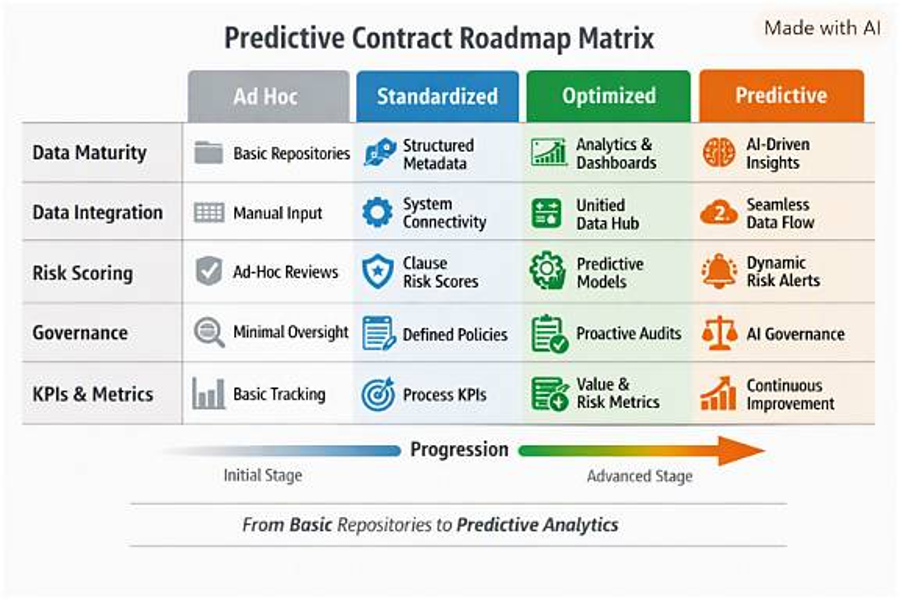
- Maturity Levels: Define stages (ad hoc → standardized → optimized → predictive) to track progress.
2. Data Sources and Integration Requirements
- Internal Sources: Contract lifecycle management (CLM) systems, ERP, CRM, procurement, compliance logs.
- External Sources: Regulatory databases, supplier performance records, litigation/arbitration outcomes, market indices.
- Integration Layer: Deploy APIs or middleware to unify structured and unstructured data.
- Data Quality Controls: Standardize clause libraries, enforce metadata tagging, and establish validation protocols.
3. Risk Scoring Methodologies
- Clause-Level Scoring: Assign weights to high-risk clauses (termination, indemnity, governing law, IP ownership).
- Counterparty Risk: Incorporate supplier reliability, financial health, and compliance history.
- Predictive Models: Use machine learning to forecast disputes, renewal likelihood, or compliance breaches.
- Dynamic Updates: Ensure scores adjust automatically with new data inputs (e.g., regulatory changes, supplier performance shifts).
4. Governance Structures
- Steering Committee: Cross-functional oversight (legal, compliance, procurement, finance, IT).
- Policy Frameworks: Define standards for contract drafting, approval workflows, and risk thresholds.
- Audit Trails: Maintain transparent logs of contract changes, approvals, and predictive outputs.
- Ethics & Compliance: Align with AI governance, data-ethics frameworks, and jurisdictional laws on automated decision-making.
5. KPIs and Success Metrics
- Cycle Time Reduction: Measure average time from draft to execution.
- Risk Mitigation: Track reduction in disputes, compliance breaches, or missed milestones.
- Value Capture: Quantify savings from renegotiated terms, avoided penalties, or optimized renewals.
- Adoption Metrics: Monitor user engagement with predictive dashboards and alerts.
- Continuous Improvement: Establish quarterly reviews to recalibrate models and update clause libraries.
Practical Tip for Implementation: Start with a pilot program focused on one contract category (e.g., supply agreements). Build a risk-scoring prototype, validate outputs against historical data, and expand gradually to other categories.
Roadmap Matrix
Caption: This roadmap matrix illustrates the evolution of contract management maturity—from basic repositories and manual oversight to predictive analytics and AI-driven governance. It provides a visual guide for organizations to benchmark their current stage and plan the next steps toward a fully integrated, risk-aware framework.
Conclusion
Building a predictive contract management framework is not a single technology deployment—it’s a strategic transformation. It requires disciplined data governance, cross-functional collaboration, and a commitment to continuous improvement. By progressing through the maturity stages—from ad hoc repositories to predictive analytics—organizations can convert contract data into actionable intelligence that drives compliance, efficiency, and value creation.
The ultimate goal is a system that learns from every contract interaction, anticipates risk before it materializes, and empowers decision-makers with foresight rather than hindsight. When implemented methodically, predictive contract management becomes a cornerstone of enterprise resilience and strategic agility.
Disclaimer: This note is provided for general informational and educational purposes only. It does not constitute legal advice, regulatory guidance, or a substitute for professional consultation. Organizations should seek independent legal and compliance counsel before implementing any contract management framework or predictive analytics solution.