
Introduction
Selecting an appropriate discount rate is a central consideration in the valuation of royalty‑based licensing arrangements. The discount rate reflects a balance between the licensor’s required return and the licensee’s cost of capital, while also incorporating industry benchmarks and the specific risk characteristics of the licensed technology. An appropriately chosen rate supports fair and defensible valuations and helps prevent the mispricing of future royalty income.
Key Considerations in Discount Rate Selection
Risk Profile of the Technology
- Early‑stage or unproven technologies generally warrant higher discount rates due to greater technical, commercial, and regulatory uncertainty.
- Mature, widely adopted technologies typically justify lower discount rates, reflecting reduced risk and more predictable cash flows.
Industry Norms
- Biotech and pharmaceutical licensing often uses higher discount rates (15–25%), reflecting long development timelines, regulatory approval risk, and capital intensity.
- Software or IT licensing commonly applies lower rates (8–12%), due to faster commercialization cycles and lower capital requirements.
Cost of Capital
The licensee’s weighted average cost of capital (WACC) provides a logical and defensible baseline for selecting a discount rate. WACC reflects the licensee’s overall cost of financing and the minimum return required to justify investment in the licensed technology.
Adjustments to WACC are typically made to reflect:
- Project‑specific risk
- Market volatility
- Competitive dynamics
Framework for Selecting Discount Rates
| Factor | Impact on Discount Rate | Example Application |
| Technology risk | Higher risk → higher rate | New biotech drug: 20% |
| Industry benchmark | Aligns with norms | Software license: 10% |
| Licensee’s WACC | Sets baseline | WACC = 9%, adjusted to 11% |
| Market conditions | Inflation, interest rates | Rising rates → higher discount |
| Deal structure | Lump‑sum vs. ongoing royalties | Ongoing royalties may justify a lower rate |
Balancing Perspectives
- Licensor’s view: Generally prefers lower discount rates to maximize the present value of expected royalty income.
- Licensee’s view: Typically advocates higher discount rates to reflect uncertainty and reduce upfront valuation.
- Negotiation outcome: Often a compromise, informed by industry benchmarks and adjusted for deal‑specific risks.
Risks of Misaligned Discount Rates
- Discount rate too high: May undervalue the technology, discourage licensing, or increase the likelihood of disputes.
- Discount rate too low: May overvalue the technology, placing undue financial strain on the licensee.
- Ignoring industry norms: Can result in agreements that are misaligned with market expectations and less competitive.
Best Practices
- Benchmark discount rates against comparable deals in the same industry and stage of development.
- Use the licensee’s WACC as a starting point, then adjust for project‑specific risks.
- Incorporate scenario or sensitivity analysis to understand the impact of different discount rates.
- Clearly document assumptions to support negotiations and reduce the risk of future disputes.
Sample Valuation Model: Impact of Discount Rates on the Present Value of Royalties
Consider a licensing agreement in which the licensee pays annual royalties of $1,000,000 for five years.
This simplified example assumes constant annual royalties paid at the end of each year, a single constant discount rate, and excludes tax, growth, probability‑weighting, and mid‑year conventions.
Present Value of Royalties
| Discount Rate | Present Value of Royalties |
| 5% | $4,329,476 |
| 10% | $3,790,787 |
| 15% | $3,352,161 |
| 20% | $2,990,580 |
Calculation Method
The present value of an annuity formula is used:
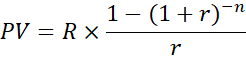
Where:
= Annual royalty payment ($1,000,000)
= Discount rate (expressed as a decimal)
= Number of years (5)
Interpretation
At a 5% discount rate, the present value of the royalty stream is approximately $4.33 million. Increasing the discount rate to 20% reduces the present value to approximately $2.99 million.
This illustrates how higher discount rates—reflecting greater risk or higher cost of capital—can significantly reduce the valuation of future royalty payments.
Conclusion
Selecting an appropriate discount rate is essential for fair and balanced royalty valuation in technology licensing agreements. Anchoring the rate to the licensee’s cost of capital, adjusting for technology‑specific risks, and validating against industry benchmarks helps align expectations between licensors and licensees, supporting successful negotiations and sustainable licensing arrangements.
References and Further Information
- https://fastercapital.com/content/License-valuation–How-to-Value-Your-License-and-Maximize-Your-Intellectual-Property-Value.html
- https://www.commercii.co.za/licence-fees-vs-royalties-in-technology-licensing/
- https://www.linkedin.com/advice/3/how-do-you-benchmark-royalty-rates-technology
Disclaimer
This practice note and valuation model are simplified examples provided for illustrative purposes only. Actual discount rates and royalty valuations should reflect specific deal terms, market conditions, and appropriate professional financial advice.